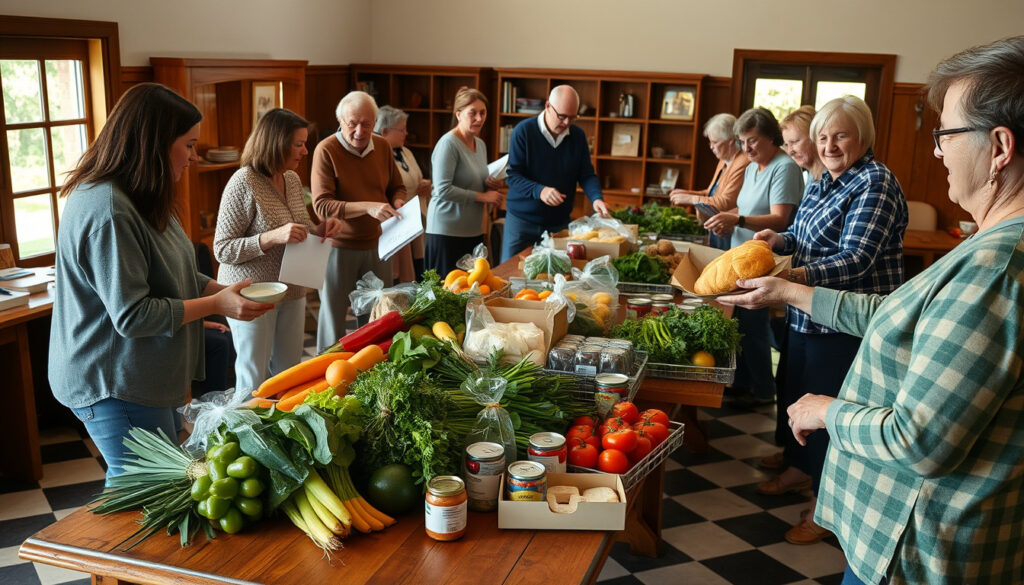
What Is a Mutual Aid Group? Definition and Examples
You’ve probably seen the term “mutual aid” pop up on social media or a neighborhood flyer, often around a crisis. It’s not a new charity app — it’s one of the oldest ways people have ever organized to take care of each other.
Core principle: Voluntary, reciprocal exchange of resources and services ·
Distinction from charity: Mutual aid is peer-to-peer, charity is top-down ·
Historical precedent: Mutual aid societies date back to at least the 18th century ·
Modern surge: Thousands of mutual aid groups formed during the COVID-19 pandemic
Quick snapshot
- Voluntary, reciprocal exchange of resources and services (National Education Association)
- Peer-to-peer and horizontal (Sustainable Economies Law Center)
- Builds solidarity and community resilience (National Education Association)
- Charity is top-down, mutual aid is peer-to-peer (LA Forward Institute)
- Mutual aid addresses root causes (LA Forward Institute)
- Creates horizontal organization (LA Forward Institute)
- Research existing mutual aid work (American Friends Service Committee)
- Start small with neighbors (Mutual Aid Disaster Relief toolkit)
- Use social media to organize (Mutual Aid Disaster Relief toolkit)
- Direct support outside of government or charity (PBS News)
- Challenges systemic inequality (LA Forward Institute)
- Fosters community power (LA Forward Institute)
The table below compiles the core facts about mutual aid groups for quick reference.
| Definition | Voluntary, collaborative exchange for common benefit |
|---|---|
| Contrast | Mutual aid is not charity |
| Examples | Community fridges, time banks, food co-ops |
| Core principle | Reciprocity and solidarity |
| Historical origin | Friendly societies and mutual aid societies, 18th century |
| Modern catalyst | COVID-19 pandemic, 2020 |
| Structure | Horizontal, peer-to-peer, non-hierarchical |
| Funding | Voluntary donations, member contributions, grants |
What exactly is mutual aid?
At its simplest, mutual aid is the voluntary, peer-to-peer exchange of resources and services for mutual benefit. The National Education Association (educator-focused publication) describes it as neighbor-helping-neighbor that builds community connections and resilience. Unlike a food bank where one party gives and another receives, mutual aid operates on the assumption that everyone has something to offer and everyone has needs.
Historical roots of mutual aid
- Friendly societies and mutual aid societies emerged across Europe and North America in the 18th century
- In the 1960s-1970s, the Black Panther Party’s survival programs — including free breakfast for children and health clinics — embodied mutual aid principles
- The modern surge in 2020 saw thousands of mutual aid groups form during the COVID-19 pandemic (National Education Association)
Every wave of mutual aid in modern history has followed a crisis or government failure. The Black Panther Party’s programs filled gaps in segregated healthcare systems. COVID-era groups formed when official channels couldn’t keep up. Mutual aid isn’t a hobby — it’s a response to unmet needs.
Modern examples
Today mutual aid groups take many forms. Nonprofit Quarterly (respected sector watchdog) describes mutual aid as the free or bartered exchange of goods between people. Community fridges — refrigerators set up on sidewalks or in public spaces, stocked and maintained by neighbors — are one visible example. Food co-ops, time banks where members trade hours of labor, and neighborhood pods that coordinate grocery shopping for elderly residents all fall under the mutual aid umbrella.
Mutual aid groups trade institutional scale for speed and trust. A government food assistance program can feed thousands; a community fridge serves a few blocks. But that hyper-local focus means the people who run it know exactly who needs what — and that reciprocity is the engine, not funding cycles.
Bottom line: Mutual aid is not charity but a horizontal system where everyone both gives and receives. Its strength lies in speed and relational trust, not scale.
What is the difference between mutual aid and charity?
This is the most common question about mutual aid, and the distinction matters for how groups operate and what they expect from participants. LA Forward Institute (community advocacy nonprofit) frames mutual aid as building systems that help communities meet their own needs through solidarity rather than charity.
Four items define the difference:
| Dimension | Mutual Aid | Charity |
|---|---|---|
| Structure | Horizontal, peer-to-peer | Top-down, donor-to-recipient |
| Power dynamic | Equal; everyone gives and receives | Unequal; one party holds resources |
| Dependency | Avoids dependency; builds agency | Can create dependency cycles |
| Root causes | Addresses systemic issues | Often treats symptoms |
| Decision-making | Consensus-based, collective | Centralized by board or director |
| Funding | Member contributions, mutual funds | Grants, donations from outside |
PBS News reported that mutual aid groups emphasize an egalitarian way of providing help with no strings attached — no applications, no means testing, no case managers. Charity asks “What do these people lack?” Mutual aid asks “What do we have between us?”
The pattern is clear: mutual aid redistributes agency along with resources, while charity maintains a power imbalance.
What is an example of a mutual aid group?
Neighborhood support networks
Hyper-local organizing at the building, block, or neighborhood scale is the most common model, as recommended by the LA Forward Institute. A single apartment building might create a Signal chat where residents post spare groceries, offer childcare swaps, or coordinate lift sharing. No budget, no bylaws, just a shared group and a willingness to help.
Mutual aid during COVID-19
The pandemic created the largest modern wave of mutual aid. The National Education Association documented groups forming across neighborhoods to deliver groceries, pick up prescriptions, and provide mask bundles. Groups used spreadsheets and social media to match volunteers with vulnerable neighbors, often within hours of a post.
Food co-ops and community fridges
Community fridges — publicly accessible refrigerators stocked and maintained by neighbors — spread rapidly during 2020. Food Not Bombs, a mutual aid network operating since the 1980s, shares free vegetarian meals in over 1,000 cities worldwide. Members contribute food, cooking labor, and serving time; no one is paid, and no one is turned away.
Disaster relief mutual aid
Mutual Aid Disaster Relief provides a full toolkit for these scenarios, recommending neighborhood pods of 5 to 20 people. The toolkit advises that if a pod grows beyond 30 members, it may be best to split into two groups to maintain trust and accountability. Mutual aid groups often form during hurricanes, floods, and wildfires where official disaster response lags.
The implication: mutual aid fills gaps that formal systems leave open, scaling by splitting rather than centralizing.
How to start a mutual aid group?
The steps below come from multiple established guides, primarily the Mutual Aid Disaster Relief toolkit and the Sustainable Economies Law Center.
- Identify community needs
- Start by researching existing mutual aid work in your area before launching a new group (American Friends Service Committee).
- Connect with organizers already doing work in the community before starting something new (Public Health Degrees resource).
- Focus on immediate, specific needs — grocery delivery, childcare, transportation — rather than broad missions.
- Build a core team
- Find a buddy or two to form a neighborhood network or pod (Mutual Aid Disaster Relief toolkit).
- A good initial size is about 5 to 20 people.
- Use the Mutual Aid 101 toolkit with organizer Mariame Kaba and Representative Alexandria Ocasio-Cortez as a starting point (AFSC).
- Establish communication channels
- Use existing networks — social media groups, neighborhood apps, community bulletin boards.
- Set community agreements: treat each other with respect, assume best intentions (Mutual Aid Disaster Relief toolkit).
- Emphasize consent around information sharing inside the pod; don’t share personal data without permission.
- Organize resource sharing
- Contribute money, material resources, or time — whatever members have available.
- Keep operations simple: one shared spreadsheet or messaging thread can coordinate everything.
- Consider written policies on membership, participation, and voting (Sustainable Economies Law Center).
- Maintain accountability
- Write down basic rules even if the group never formally incorporates (Sustainable Economies Law Center).
- Adopt a safety policy, especially for in-person interactions or COVID-19 precautions.
- Avoid hierarchy — use consensus decision-making rather than elected leadership.
Mutual aid groups can be completely volunteer-run and grassroots-led, according to the Sustainable Economies Law Center. But without even minimal written agreements, groups that grow beyond a handful of trusted neighbors risk burnout, miscommunication, and unresolved conflicts. A single page of community agreements is cheap insurance against collapse.
What is the purpose of mutual aid?
Mutual aid as a form of resistance
Mutual aid directly challenges the idea that people in need should wait for formal systems to help them. The National Education Association frames mutual aid not just as service delivery but as “an act of resistance and community support.” When governments or markets fail to meet basic needs, mutual aid fills the gap on the community’s own terms.
Building community resilience
Resilience in a mutual aid context isn’t abstract — it’s the ability of neighbors to coordinate care faster than any agency can. A pod that already has a shared text chain, a list of members’ skills, and a stocked emergency fund can respond within hours to a job loss, illness, or natural disaster. The LA Forward Institute emphasizes hyper-local organizing specifically because it builds those responsive relationships before a crisis hits.
Meeting unmet needs
The primary purpose of mutual aid is to provide direct support outside of government or charity. PBS News documented how mutual aid groups during the pandemic filled gaps in everything from food access to mental health support that formal institutions couldn’t reach. The purpose isn’t to replace public services — it’s to cover what they miss.
The implication: Mutual aid addresses both material need and political isolation. A person who joins a community fridge project doesn’t just get food — they become part of a group that knows their name, cares whether they’re safe, and will show up when something goes wrong. That relational infrastructure is the point.
Confirmed facts and what’s unclear
Confirmed facts
- Mutual aid is voluntary, reciprocal exchange (National Education Association)
- Mutual aid predates modern charity systems
- Mutual aid groups operate horizontally, not hierarchically
- Thousands of groups formed during the COVID-19 pandemic
- Recommended initial group size is 5 to 20 people (Mutual Aid Disaster Relief)
What’s unclear
- Whether mutual aid can scale beyond local communities
- Exact number of mutual aid groups globally
- Long-term sustainability of informal, volunteer-run groups
- How to measure effectiveness compared to traditional social services
- Whether mutual aid can effectively address deep-rooted systemic inequality at scale
“Mutual aid is the voluntary, peer-to-peer exchange of resources and services for mutual benefit.”
National Education Association
“Mutual aid builds solidarity, helping everyone involved by creating new communities of care.”
Timeline signal
- 18th century: Friendly societies and mutual aid societies emerge in Europe and North America — workers pool wages to cover sickness and burial costs
- 1960s-1970s: Black Panther Party’s survival programs embody mutual aid — free breakfast, health clinics, and food distribution
- 2020: Thousands of mutual aid groups form during the COVID-19 pandemic, coordinated largely through social media and messaging apps (PBS News)
What this means: Mutual aid is not a passing trend. Each wave has built on the last, with digital tools accelerating coordination but the core model — neighbors sharing what they have — remaining unchanged for centuries.
Frequently Asked Questions
Is mutual aid the same as community organizing?
Not exactly. Community organizing typically aims to build power to influence institutions — electing leaders, changing policies. Mutual aid focuses on meeting immediate material needs through direct, peer-to-peer exchange. They often overlap: many mutual aid groups grow into organizing efforts, and many organizers see mutual aid as a foundation for political work.
Can mutual aid be political?
Yes, and it often is. The National Education Association describes mutual aid as “an act of resistance.” When a community builds its own safety net outside of government or corporate charity, that is inherently a political statement about who should hold power and resources.
What is a mutual aid society?
A mutual aid society is a formal organization — often non-profit or cooperative — that pools member contributions to provide insurance, social services, or other benefits. Historical mutual aid societies included fraternal orders like the Odd Fellows. Modern versions include credit unions and cooperative insurance groups. They are structured around membership and reciprocity rather than charity.
How is mutual aid funded?
Mutual aid groups are often funded by voluntary member contributions, direct donations from supporters, and occasional grants. According to the Sustainable Economies Law Center, groups can be completely volunteer-run and grassroots-led, though some incorporate as non-profits to accept tax-deductible donations.
Are mutual aid groups tax-exempt?
Not automatically. Informal mutual aid groups that don’t incorporate or apply for 501(c)(3) status are not tax-exempt. The Sustainable Economies Law Center recommends written policies and careful consideration of legal structure, especially if the group handles significant funds or plans to accept grants.
What are the challenges of mutual aid?
Mutual aid groups face burnout among volunteers, difficulty sustaining participation over time, lack of funding, and potential internal conflicts. The Mutual Aid Disaster Relief toolkit addresses this by recommending clear community agreements, limits on group size, and explicit consent protocols for sharing information.
How do mutual aid groups handle accountability?
Accountability in mutual aid is typically relational, not bureaucratic. Since groups are small and peer-to-peer, members hold each other accountable through direct conversation, shared agreements, and collective decision-making. Some groups adopt formal conflict resolution processes or restorative justice practices when disagreements arise.
For anyone looking to start a mutual aid group, the pattern is clear: start small, build trust, and write down your agreements before you need them. The trade-off between institutional scale and local responsiveness is real, but for communities that have been failed by formal systems, the ability to organize care on their own terms is worth more than any grant.
Related reading
- Hva er et P2P-nettverk? Definisjon, eksempler og sikkerhet — while focused on technology peer-to-peer networks, the concept of distributed, non-hierarchical exchange shares conceptual roots with mutual aid organizing
- Hva er CO₂? En enkel forklaring og alt du trenger å vite — a basic explainer that models how to break down a complex concept for general audiences, similar in approach to this mutual aid guide
Flere relaterte innlegg
 By i Nederland kryssord – Oversikt over nederlandske byer
 Når kommer posten til meg? – Sjekk leveringsdag for din adresse
 Jamie Lee Arrow: Siste nytt om datteren av Skara-kannibalen
 Isbreer i Norge – Antall, største og smelting
 Tobias Sten konsert 2026 – datoer, aldersgrense og billetter
 Man City mot Dortmund 4-1: Resultat, høydepunkter og analyse
 Svein Vidar Knutsen – Fakta, bakgrunn og kontroverser
 Hvilken uke er det i dag? Ukenummer 2026
